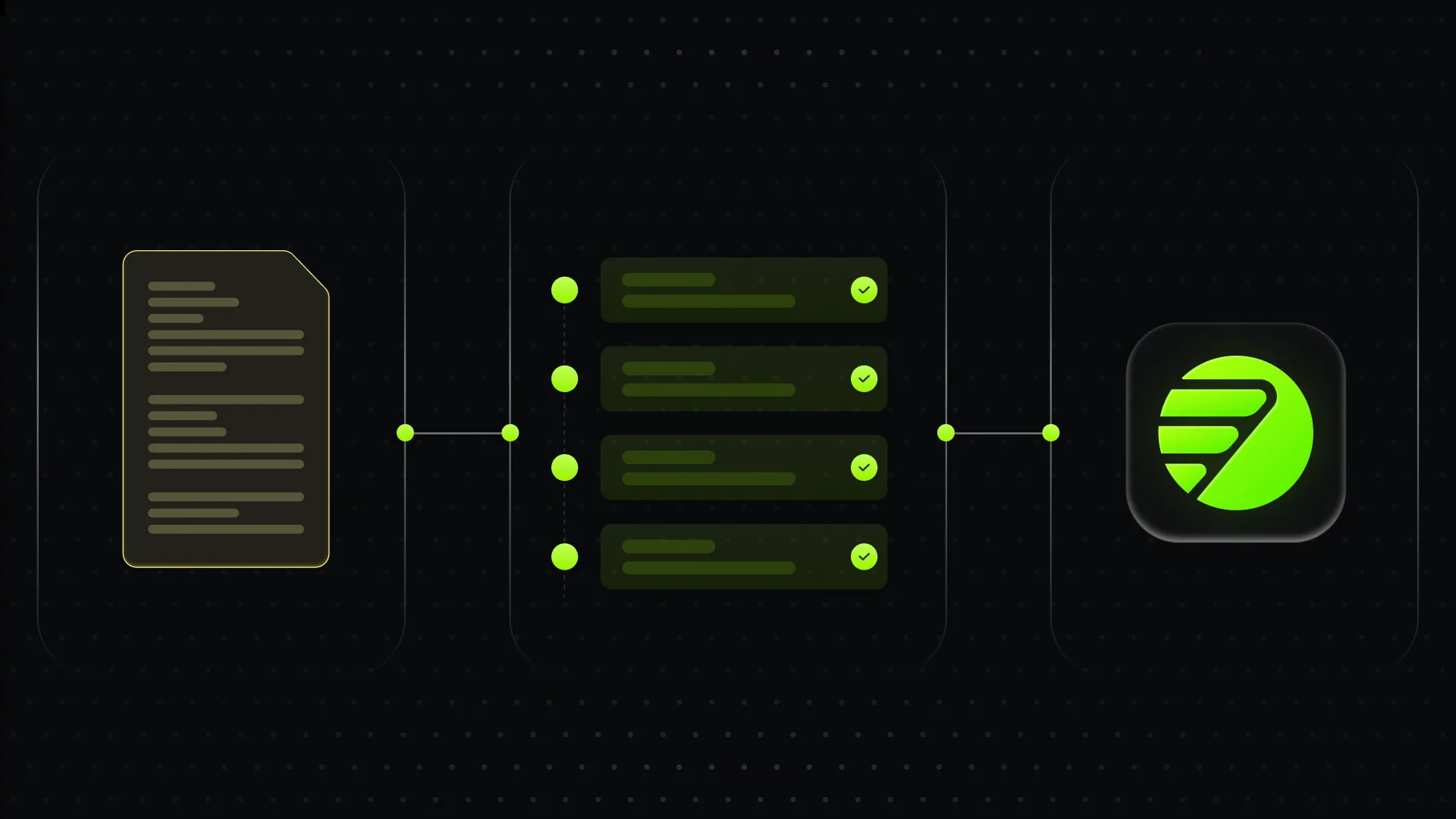
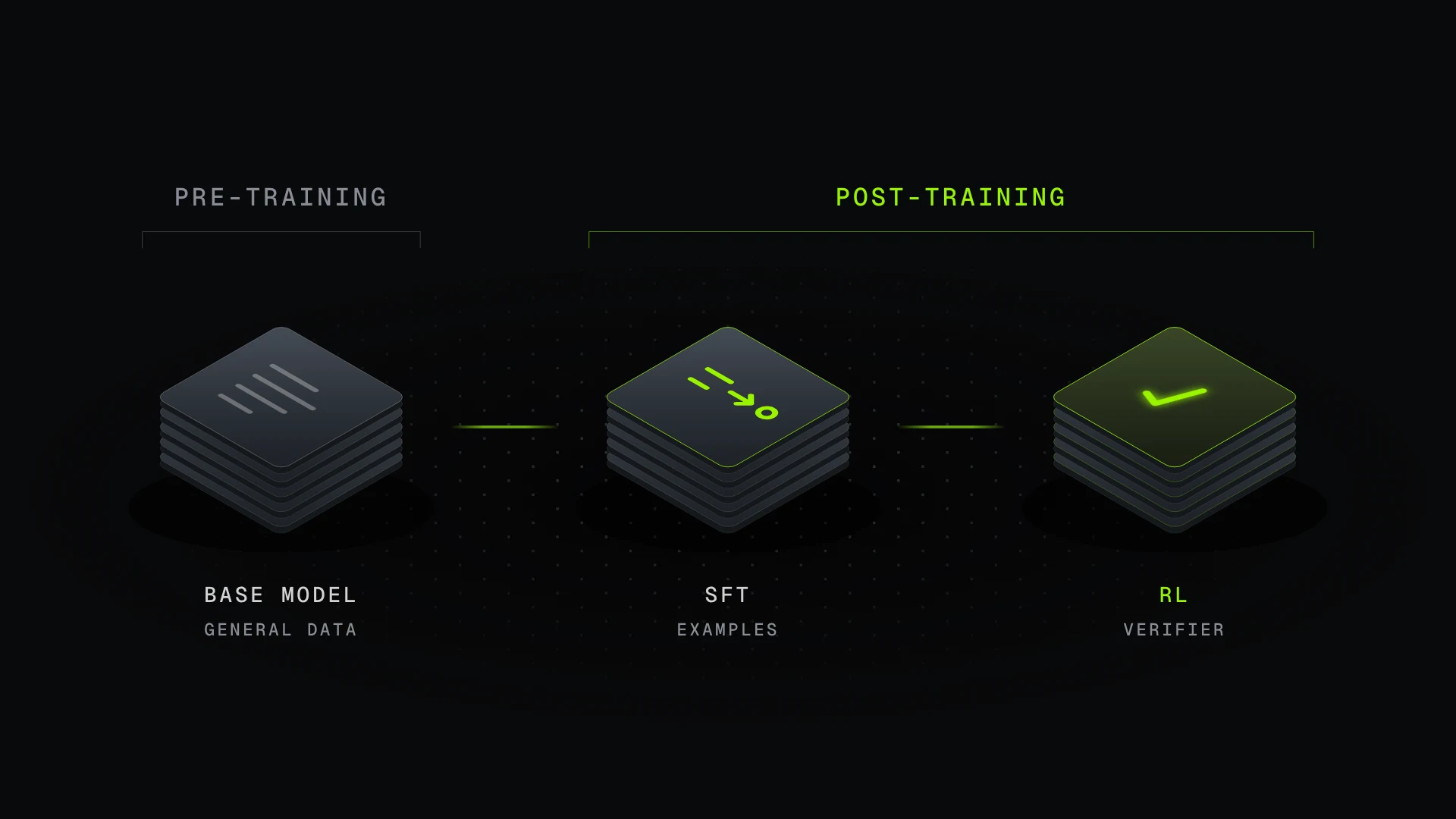
Post-training is the stage that turns a general model into one that does specific work. Pre-training gives a model language and general knowledge. Post-training teaches it how to use them, for one job or many. The model first learns from examples of the work, then from feedback on its own attempts, until it makes the call the way your team would.
Every chat model you have used went through it. The same methods can also teach a smaller model one job your team does thousands of times. This guide explains what post-training changes, how its steps fit together, and when it is worth starting.
What post-training changes
A model straight out of pre-training is good at continuing text. It is not yet good at following an instruction, keeping to a format, or making the same call consistently. Post-training closes that gap.
Training for the job can matter more than size. The Lawma study, presented at ICLR 2025, built 260 classification tasks from US Supreme Court and federal appeals court records. A fine-tuned 8-billion-parameter model scored 87%. The best commercial model, Claude 3.7 Sonnet, scored 78%, despite being orders of magnitude larger.
Post-training can also teach a model context it did not have: your team’s terms, rules, and the judgment behind past decisions. Facts that change every week are easier to keep current with retrieval. Done well, a smaller, cheaper model can match or beat frontier models on that work, with results that hold up run after run.
The map
Building a model happens in two stages, and most of the terms people mix up belong to the second one.
- Pre-training builds the base model from a very large amount of text. Few teams ever do this step.
- Prompting and RAG use that model as it is. A prompt tells it what to do. Retrieval-augmented generation (RAG) hands it documents to read before it answers. Neither changes the model itself.
- Post-training changes the model. It usually runs in steps: supervised fine-tuning on examples, then reinforcement learning on scored attempts.
The naming is part of the confusion. “Fine-tuning” is the broad word for any further training of a model. Supervised fine-tuning (SFT) is one kind of it. Post-training is the whole stage after pre-training, which includes SFT and the feedback steps that follow.
The most complete public example of that stage is Olmo 3, released by the Allen Institute for AI in late 2025 with its data, code, and tests all published. It starts with SFT and ends with a step where the model’s attempts are graded automatically, and the authors report gains at each step. That last step is reinforcement learning with verifiable rewards (RLVR), one way to score a model’s attempts without a person checking each one.
What is supervised fine-tuning?
Supervised fine-tuning trains a model on examples of an input and the correct output, so it learns to produce that output for new inputs of the same kind. It is usually the first step of post-training.
Supervised, unsupervised, and rewarded
The three ways a model learns map onto the three stages:
- Pre-training is mostly self-supervised. The model reads a very large amount of raw text and learns to predict the next word. Most of that text has no labels.
- SFT is supervised. Each example comes with the answer a person or system marked as correct.
- Reinforcement learning is rewarded. The model makes an attempt, gets a score, and shifts toward attempts that scored well.
What SFT data looks like
Each example pairs an input with the correct output. Training data is often stored as a short chat: the input is the user’s message, and the correct output is the model’s reply. Suppose a support team sorts every incoming ticket into a refund, a replacement, or a reply. An example is one past ticket and the category an agent chose for it.
Examples usually come from two places. One is work your team has already done, like tickets an agent sorted. The other is logs, or traces, from a system already doing the job, such as a frontier model’s past answers, kept only where the result was checked and correct. A few hundred to a few thousand of those, checked for consistency, become the training set.
The output can be a label, a filled-in form, or a short written answer. What matters is that two people on the team would mark the same example the same way. If they would not, the model learns the disagreement.
How much data you need
Less than most teams expect, for a narrow job. The Lawma authors found that a few dozen to a few hundred labeled examples were usually enough for a fine-tuned model to beat the commercial ones on a legal task. In a 2025 Stanford study, researchers fine-tuned a 32-billion-parameter model on 1,000 worked math problems in 26 minutes of training. Combined with a simple trick that makes it think longer, it beat OpenAI’s o1-preview on competition math.
Competition math is not a business task, and the right number depends on the job. The point that carries over is the shape of the work. A repeated decision with marked examples is where a trained model has an edge.
What SFT is good and bad at
SFT is good at teaching a format and a repeated decision. It can add new facts too, but done carelessly it makes the model guess more. A 2025 UC Berkeley study presented at NAACL found that when a model is fine-tuned on facts it did not know, its made-up answers later copy the answers from those unfamiliar examples. Train those same examples to answer “I don’t know,” and the model learns to say that instead. Facts that change often are easier to keep somewhere the model can look them up, which is covered below.
SFT vs RL
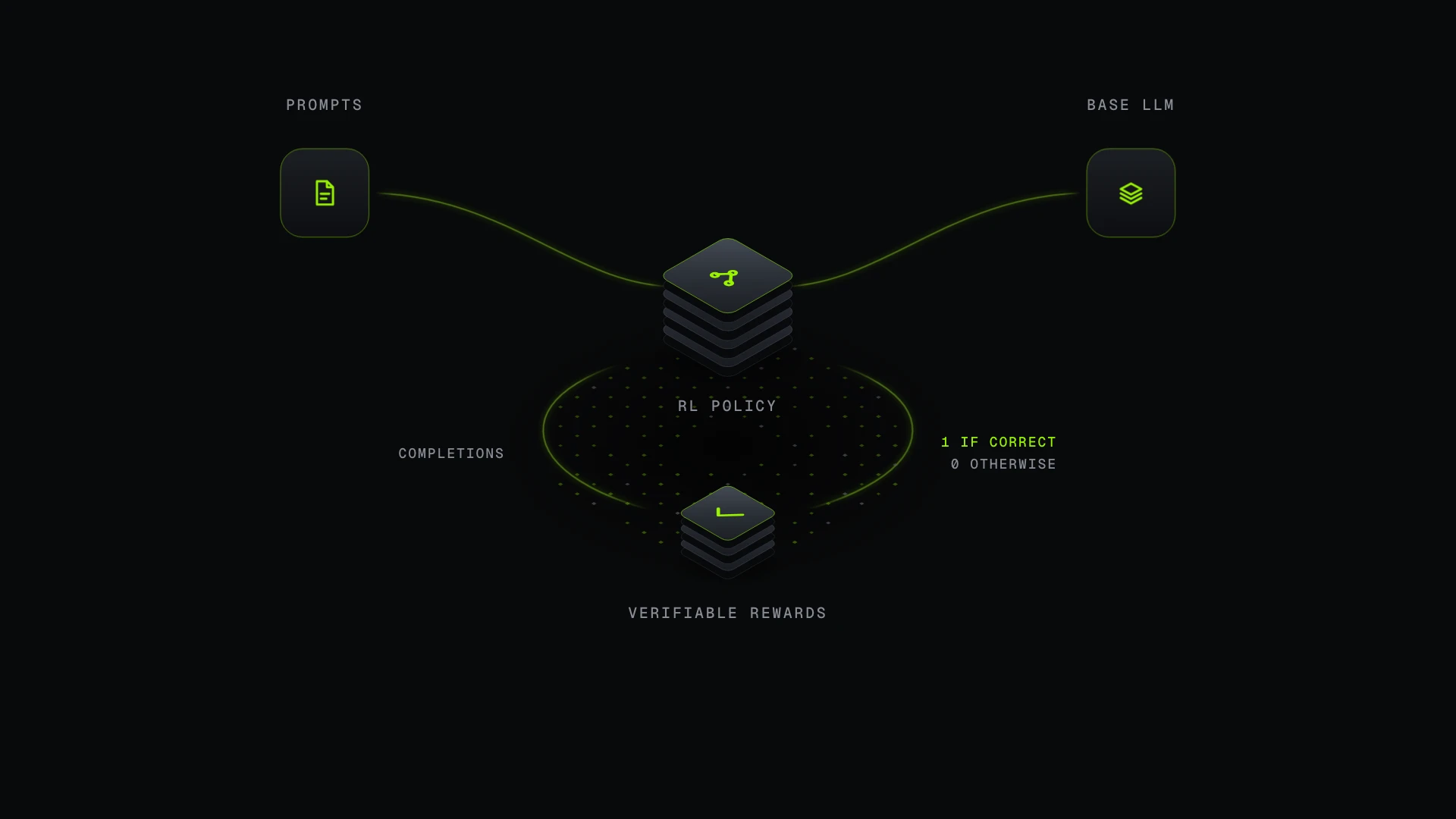
SFT teaches from examples of the right answer. Reinforcement learning (RL) teaches from a score on the model’s own attempts. One shows the model what correct looks like. The other lets it try and tells it how well it did.
The score comes from a verifier: a check that grades each attempt automatically, by running a test, comparing to a known answer, or applying your team’s rules. Because no person grades each attempt, the model can practice on thousands of them. This is reinforcement learning with verifiable rewards (RLVR), the last step of the Olmo 3 recipe above.
The difference shows up on new cases. In “SFT Memorizes, RL Generalizes”, a 2025 study with researchers from UC Berkeley and NYU, models trained with reinforcement learning held up on variations of a task they had not seen, while SFT-trained models did worse. The same study found SFT was still needed first, to get the output into a format the verifier could score.
LoRA
LoRA is a cheaper way to do the same training step. Instead of changing every weight in the model, it freezes the original and trains a small set of added weights. A 2025 MIT study at NeurIPS found that LoRA can reach the same accuracy as full fine-tuning and forgets less of what the model could already do. It also changes the model in a different way, and those changes can build up if the same model is trained again and again. Test it against your held-out examples like any other model.
Where RAG fits
RAG and post-training solve different problems. RAG gives a model the facts it needs at the moment it answers. Post-training changes how the model does a job.
A 2026 UC Irvine study tested this, including on questions about 2024 events the models had never seen. Continued training on raw text barely helped. Retrieval gave large, consistent gains. Fine-tuning on question-and-answer pairs scored highest overall, so training can teach new facts, but retrieval is the easier way to keep them current. So a team that needs the model to know its product catalog or policy manual should start with retrieval. A team that needs the model to make one decision the same way every time is looking at post-training. Many systems use both: retrieval supplies the facts, and a trained model does the job with them.
Is post-training cheaper than a frontier API?
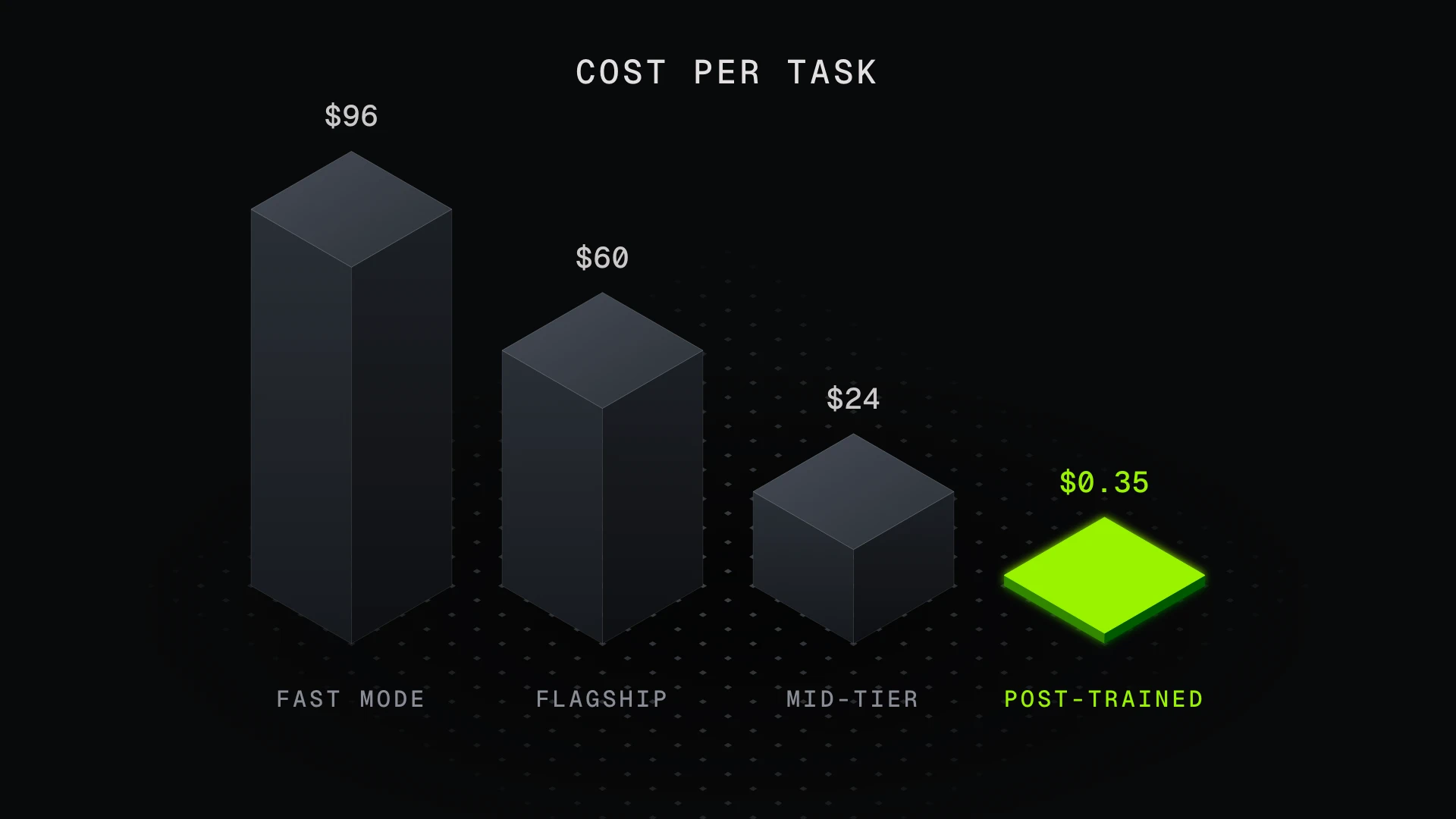
Post-training trades a one-time build cost for a much lower price per task. It saves money only above a certain volume.
A 2025 Columbia and NYU study fine-tuned open models to read pancreatic CT and MRI reports. They matched GPT-4o’s accuracy, at 97–98% on feature extraction. Each 100 reports cost about $0.025, against $1 on GPT-4o, so the one-time training paid for itself after about 9,100 reports.
A business build also includes engineering time and upkeep. When post-training pays back puts that against monthly frontier-API spend: about $5K a month per workflow.
When post-training is worth starting
Post-training needs a few things in place before it can work:
- One narrow, stable decision. “Which category is this ticket?” works. “Handle customer support” does not.
- A way to mark a correct answer. Someone on the team can say what right looks like, and two people would agree.
- Examples from your own work. Past decisions, already made and checked, in the format the model will see.
- A held-out set. Examples kept out of training, so you can test the trained model on cases it has not seen.
- Enough repetition. The same decision runs often enough that the cost of re-deciding it on a frontier model is worth questioning. Whether the volume is high enough is the cost question above.
How a post-training project runs
The order matters more than the tooling:
- Scope one decision. Write down the input, the possible outputs, and how a correct answer is marked. A post-training assessment can test whether a decision is worth training.
- Hold out a test set first. Set aside examples before training starts, so they never leak into it.
- Train. Usually SFT first, then reinforcement learning with a verifier that grades the model’s attempts.
- Compare. Test the trained model, the model it started from, and the general model you use today on the held-out set. Measure accuracy, cost, and speed separately.
- Run it beside the current model. Send the same real work to both and check where they disagree.
- Cut over, or don’t. Switch only if the trained model holds up on all three measures you care about. If it doesn’t, keep what you have.
When to skip it
Post-training is the wrong tool more often than it is the right one. Skip it when:
- Quality is a matter of taste, not a test. If nobody can mark an answer right or wrong, there is nothing to train against.
- The task changes every sprint. A model trained on last month’s rules will be wrong about this month’s.
- A cheaper general model already passes. If an off-the-shelf model meets the bar on your held-out set, use it.
- The volume is too low. If the decision runs a few hundred times a month, the build may never pay back. See “Is post-training cheaper than a frontier API?” above.
Where it shows up
Document review is one place the fit is clear: the same question asked of thousands of documents, with lawyers who can mark the right answer. The legal document review guide walks through published studies where trained small models matched or beat general models on contract checks, sorting, and extraction.
Other good candidates look similar. Sorting tickets, filling a fixed form from a document, flagging a policy breach, matching an invoice to an order. Each is one decision, repeated, with a right answer someone can mark.
Train one model for one job
Hookshot™ Models is a serverless post-training platform that lets software engineers train a model on one repeated job without a dedicated machine-learning team. Your team brings the examples and the test set. Hookshot trains the model, compares it with the one you use today, and returns a model you can deploy on dedicated infrastructure, as a serverless endpoint, or on-premises.